
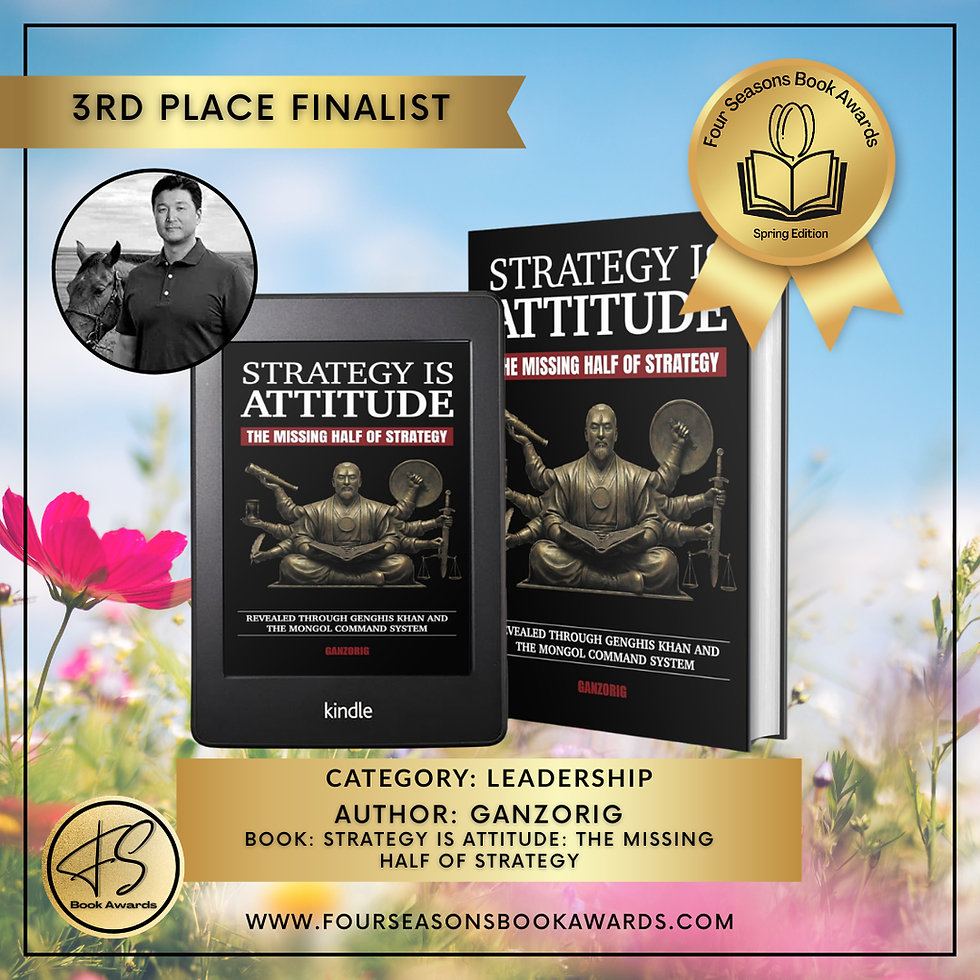
Strategy Is Attitude: The Missing Half of Strategy by Ganzorig
Editorial Review - Voices of Excellence
Author Ganzorig
5 Star Review
3rd Place Leadership
Spring Edition 2026
Click HERE

Strategy Is Attitude: The Missing Half of Strategy presents a provocative examination of what it means to think strategically. Rather than introducing another analytical framework or collection of conventional strategy tools, Ganzorig challenges a foundational assumption in strategic thinking: that effective strategy is primarily the product of conscious analysis. The book argues that strategic judgment also depends on the attitudes and mental orientations that shape how individuals subconsciously interpret information and perceive reality.
This central premise gives the book a distinctive position within the broader strategy literature. Traditional approaches frequently emphasize processes, frameworks, data, planning, and analytical rigor. Strategy Is Attitude shifts attention toward the strategist themselves, asking a different question: before examining how strategy is formulated, what determines whether a strategist is capable of seeing a situation accurately in the first place?
The book’s discussion of conscious and subconscious processing provides an intriguing conceptual foundation. Ganzorig proposes that strategic decisions involve more information and complexity than the conscious mind can comfortably process, making underlying mental orientations particularly important. From this perspective, strategy is not simply about collecting more information or applying increasingly sophisticated analytical tools. It is also about developing the attitudes that influence what information receives attention, how uncertainty is interpreted, and which patterns become visible.
One of the book’s most distinctive features is its use of Genghis Khan as a historical case study. Rather than focusing exclusively on battlefield tactics or territorial expansion, the book examines the organizational and leadership mechanisms associated with the Mongol command system. Ganzorig's argument is that the significance of Genghis Khan lies not merely in his individual strategic ability, but in his ability to cultivate strategic capability within others. This provides the historical foundation for the book’s broader question: can strategic judgment be developed systematically rather than remaining an exceptional quality possessed by a single leader?
The comparisons with figures such as Alexander and Napoleon further develop this argument by directing attention toward the challenge of transferring strategic capability beyond an individual leader. Whether readers ultimately accept the book’s historical interpretation, the comparison creates an engaging framework for considering an important organizational problem: how can institutions develop people who are capable of making sound judgments independently rather than relying indefinitely on a central decision-maker?
The book is particularly relevant to leaders, strategists, entrepreneurs, and organizational thinkers interested in decision-making under uncertainty. Its emphasis on perception and mental orientation encourages readers to examine the assumptions that precede analysis. In practical terms, this can prompt valuable questions about organizational culture, leadership development, strategic education, and the ways individuals respond when information is incomplete or contradictory.
Another strength is the book’s willingness to challenge conventional strategic orthodoxy. Rather than assuming that better tools automatically produce better strategy, it questions whether tools can compensate for flawed perception. This creates a useful tension between methodology and mindset and invites readers to consider whether strategic education has placed too much emphasis on what strategists do and too little on how they approach the world.
From an editorial perspective, Strategy Is Attitude has a clearly defined intellectual proposition and a compelling organizing metaphor. Its combination of strategic theory, psychology, leadership, and military history gives it a multidisciplinary character, while the historical example of Genghis Khan provides a narrative through-line for the argument. The subject matter is ambitious, but the underlying question remains accessible: what separates someone who knows strategic tools from someone who can actually think strategically?
Overall, Strategy Is Attitude offers a thought-provoking contribution to discussions about strategy and leadership. Its central argument—that strategic capability depends not only on analytical processes but also on the attitudes that shape perception and judgment—encourages readers to reconsider how strategists are developed. By connecting this idea to the historical example of Genghis Khan and the problem of building strategic capability within organizations, Ganzorig presents a distinctive perspective on why strategy may depend as much on the mindset behind the analysis as on the analysis itself.


Comments