
Strategy Is Attitude: The Missing Half of Strategy by Ganzorig
- Aug 3
- 8 min read
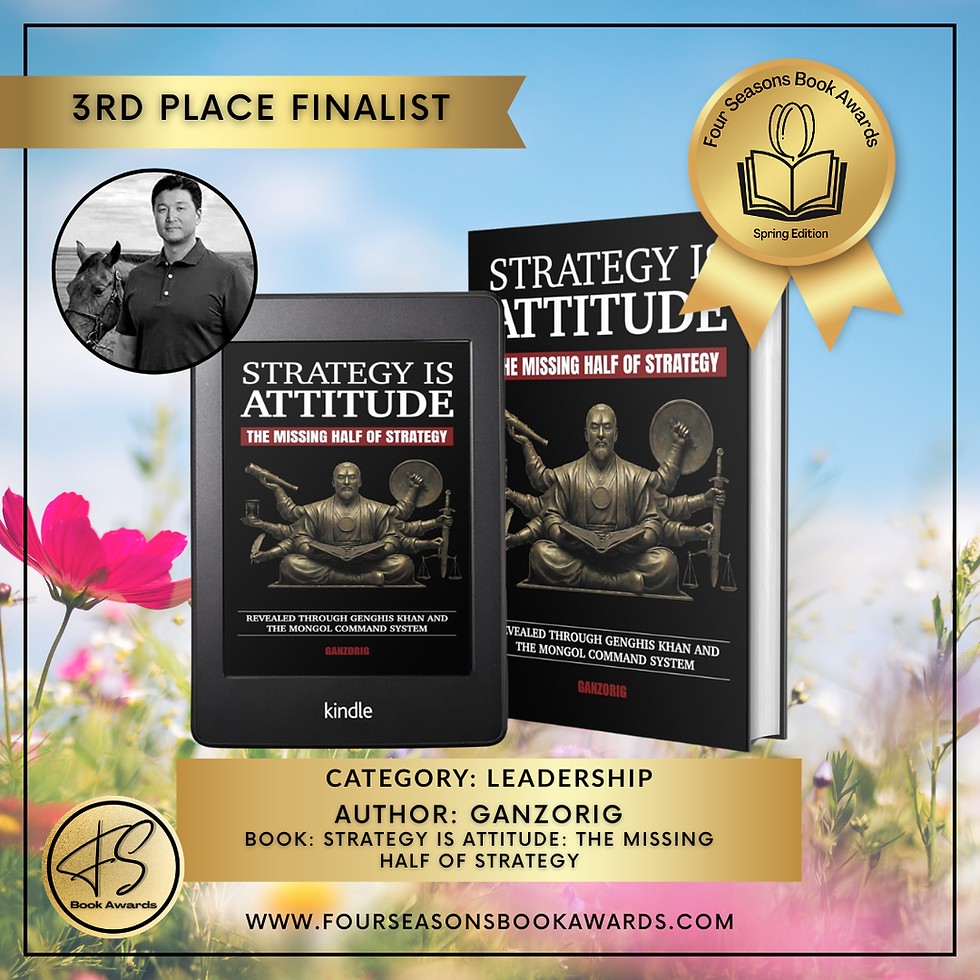
Editorial Review - Voices of Excellence
Author Ganzorig
5 Star Review
3rd Place in Leadership
Spring Edition 2026
Click HERE to Get Your Copy Today!

Organizations rarely suffer from a shortage of strategic tools. They have models for analyzing competitors, mapping markets, allocating resources, forecasting scenarios, and measuring performance. Yet sophisticated plans still fail—sometimes because execution falters, but often because the people creating them misread the situation from the beginning. In Strategy Is Attitude: The Missing Half of Strategy, Ganzorig argues that the problem lies deeper than process. Strategy depends not only on what leaders analyze, but on the attitudes that determine what they are capable of seeing.
It is an ambitious reframing. Conventional strategy tends to privilege conscious thought: gather information, apply a framework, evaluate alternatives, and select a course of action. Ganzorig does not reject that sequence. Instead, he contends that it represents only half of strategic work. Beneath formal analysis operates a less visible layer of assumptions, habits, emotional orientations, and intuitive judgments. These influence which evidence attracts attention, which threats are minimized, and which possibilities are dismissed before deliberate reasoning begins.
The book’s key distinction is useful. Process provides a method; tactics convert decisions into action; attitude orients the strategist toward reality. A process may be executed correctly while producing a strategically disastrous conclusion if its participants are protecting status, defending an outdated belief, or interpreting uncertainty through fear. Analysis does not automatically correct such distortions. It may give them a more impressive vocabulary.
The Mind Behind the Framework
Ganzorig’s theory rests on the proposition that strategy is too complex to be handled entirely by conscious reasoning. Strategic environments contain incomplete information, shifting incentives, institutional politics, and consequences that cannot always be calculated in advance. Experienced decision-makers therefore rely partly on pattern recognition and judgment developed through repeated exposure.
Research on expertise, intuition, cognitive bias, and implicit processing lends general support to the idea that much human judgment occurs beyond conscious deliberation. It does not, however, establish every broader claim one might make about the subconscious. Intuition can represent compressed experience, but it can also encode prejudice, overconfidence, and lessons drawn from circumstances that no longer apply. A feeling of certainty is not proof of accurate perception.
The book’s contribution lies in refusing to romanticize formal analysis as neutral. Strategists do not encounter reality without filters. Ego can make contradictory evidence feel threatening. Ideology can transform an assumption into an unquestioned fact. Status may discourage a subordinate from reporting bad news, while past success can persuade leaders that a changing environment will continue to reward familiar behavior.
Attitude becomes strategically important because it shapes how people respond when reality resists the plan. Can they revise an assumption without experiencing revision as humiliation? Can they tolerate uncertainty long enough to investigate it? Can they distinguish a genuine opportunity from a projection of their own ambition? These are not merely questions of technique. They concern the strategist’s orientation toward evidence, responsibility, and error.
The strongest version of Ganzorig’s argument is therefore not that subconscious intuition should replace conscious analysis. It is that each must discipline the other. Intuition can identify patterns before they are fully articulated; structured analysis can test those impressions. Attitude determines whether the strategist is willing to participate honestly in that exchange.
Genghis Khan and the Architecture of Judgment
Ganzorig uses Genghis Khan as the book’s principal historical case study, shifting attention away from individual battlefield brilliance toward organizational design. His central claim is that Genghis Khan’s most consequential achievement was the creation of a command system capable of developing strategic judgment across multiple leaders. In the author’s formulation, he did not merely produce victories; he produced strategists.
This perspective helps explain why delegation, merit, discipline, information-sharing, adaptability, and leadership development matter as much as tactics. An organization dependent on a founder’s personal insight may appear formidable while that founder remains in command, yet prove incapable of reproducing sound judgment afterward. A more durable system distributes responsibility and teaches people how to interpret changing conditions rather than simply follow instructions.
Jack Weatherford’s endorsement recognizes the originality of locating Genghis Khan’s strategic genius in attitude rather than tactics. That observation is meaningful because Weatherford’s work helped introduce broad audiences to the administrative and organizational dimensions of the Mongol Empire. Still, the endorsement cannot resolve the historical questions the book raises.
The phrase “mass-produced strategists” is memorable, but it requires careful qualification. Mongol success emerged from multiple factors: mobility, intelligence networks, military organization, political alliances, discipline, technological adaptation, and the weaknesses or divisions of opponents. Establishing that attitude caused strategic dominance—rather than accompanied or reinforced these advantages—is difficult. Historical interpretation becomes most convincing when evidence is transparent, competing explanations are considered, and examples that complicate the theory receive attention alongside those that support it.
Any assessment must also separate effectiveness from morality. The Mongol campaigns involved
Official retailer and book-site metadata credit the author as “Ganzorig,” while the author’s website identifies him more fully as Ganzorig Ulziibayar. The review below follows the book’s official single-name credit. Official book website
Beyond the Framework: Rethinking the Inner Architecture of Strategy
Strategic failure is rarely blamed on a shortage of frameworks. Organizations have access to sophisticated models, extensive data, experienced consultants, and increasingly powerful analytical tools. Yet leaders still misread competitors, cling to failing assumptions, overlook emerging threats, and confuse internal consensus with external reality. In Strategy Is Attitude: The Missing Half of Strategy, Ganzorig argues that this persistent gap exists because strategy has been defined too narrowly. The problem is not simply how people analyze information, but the orientation they bring to the act of seeing it.
That distinction gives the book its intellectual force. Conventional strategy education tends to emphasize formal process: defining objectives, studying conditions, evaluating options, allocating resources, and selecting actions. Tactics determine what happens next. Attitude, in Ganzorig’s formulation, operates at a more foundational level. It influences what strategists notice, what they dismiss, how they interpret uncertainty, and whether evidence is allowed to challenge identity, hierarchy, fear, or ambition.
The result is an ambitious expansion of strategic thought. Strategy is not presented merely as a plan produced through conscious reasoning, but as a form of judgment shaped by both deliberate analysis and subconscious processing. Whether readers accept every element of that theory, the book raises a valuable question: what good is an excellent framework if the person using it cannot perceive reality clearly?
The Mind Behind the Method
Ganzorig’s argument is strongest when attitude is understood not as optimism, confidence, or motivational intensity, but as an orientation toward reality. A strategist may possess technical knowledge and still search selectively for confirming evidence. An executive may invite criticism while unconsciously punishing those who provide it. An institution may collect accurate information and then distort its meaning to protect status, ideology, or an established course of action.
Under these conditions, analysis does not necessarily correct bias. It can become a sophisticated instrument for defending it.
The book connects this problem to subconscious processing, proposing that strategy is too complex to be managed entirely through conscious calculation. Real strategic environments contain incomplete information, shifting incentives, competing time horizons, and human behavior that cannot be reduced to stable variables. Experienced decision-makers often recognize patterns or sense inconsistencies before they can fully articulate why.
Research on expertise, implicit learning, cognitive bias, and intuition supports the general idea that much human judgment occurs outside conscious awareness. The broader claim that strategy fundamentally “belongs” to the subconscious is more theoretical and should be treated accordingly. Intuition can encode years of relevant experience, but it can also preserve prejudice, overconfidence, and outdated patterns. A feeling of certainty is not evidence of accuracy.
The most useful interpretation of Ganzorig’s thesis is therefore not that subconscious judgment should replace analysis. It is that formal reasoning and cultivated intuition must challenge and refine one another. Data can expose the limits of instinct; experience can reveal what a model has failed to include. Strategic attitude matters because it determines whether leaders remain open to that correction.
This relationship has immediate practical relevance. Leaders working under uncertainty need to recognize when assumptions have failed, distinguish warning signals from noise, and learn without allowing ego to rewrite the lesson. Reliable intuition is not an innate gift. It develops through experience, honest feedback, disciplined reflection, and repeated contact with consequences.
Genghis Khan and the Creation of Strategists
The book’s most original move is to use Genghis Khan not primarily as an example of battlefield brilliance, but as the architect of a system that distributed strategic capability. Ganzorig argues that his defining achievement was the creation of a command structure able to develop judgment in others and preserve strategic effectiveness beyond its founder.
This interpretation shifts attention from the mythology of the singular genius to organizational design. Delegation, merit-based advancement, disciplined communication, adaptability, information sharing, and authority granted to capable commanders allowed decisions to be made across a vast and rapidly changing field of operations. Strategic capacity was not held entirely at the center; it was cultivated throughout the command system.
The phrase “mass-produced strategists” is deliberately provocative. It captures the distinction between an organization that executes one leader’s instructions and one that develops people capable of interpreting conditions independently. For contemporary institutions, that difference is substantial. A company may have an exceptional founder yet remain strategically fragile if every consequential judgment depends on that person. A durable organization needs shared principles, distributed responsibility, strong information flows, and leaders who can act intelligently when no script applies.
Jack Weatherford’s endorsement highlights the originality of treating attitude, rather than tactics, as the engine of Genghis Khan’s strategic effectiveness. The historical case is indeed compelling, but it requires ethical and analytical restraint. Mongol military success was accompanied by conquest, mass violence, and devastation. Effectiveness should not be mistaken for moral legitimacy, and admiration for organizational capability must not become romanticization of its uses.
Historical causation also resists a single explanation. Geography, military technology, logistics, political fragmentation among opponents, mobility, intelligence networks, and the capabilities of later commanders all contributed to Mongol expansion. Attitude and command culture may illuminate that achievement without fully accounting for it.
From Empire to Enterprise
Ganzorig contrasts Genghis Khan’s institutional legacy with those of Alexander the Great and Napoleon, whose systems did not preserve comparable strategic dominance after their departure. The comparison sharpens the difference between individual brilliance and transferable capability. It also risks compressing leaders separated by radically different political structures, technologies, succession arrangements, and historical circumstances into a cleaner contrast than the evidence may permit.
The claim that no modern corporation has created an equivalent system is similarly stimulating but difficult to prove. Many organizations have developed leadership pipelines, decentralized operating models, succession systems, and cultures of continuous learning. Few do so consistently, and fewer preserve adaptability once size, politics, and risk aversion take hold. Ganzorig’s assertion is most useful as a challenge rather than a settled historical verdict: can an institution reliably develop strategic judgment, or does it merely train people to reproduce approved processes?
This question connects the book’s medieval case study to modern environments. Executives, founders, consultants, military leaders, and public-sector officials routinely operate with incomplete information while navigating institutional incentives and competing interpretations of reality. In such settings, a strategic plan can become obsolete before it is fully implemented. Organizations need people who understand the intent behind a strategy and possess the judgment to adapt it responsibly.
The practical test of Ganzorig’s theory is whether attitude can be cultivated rather than merely admired. Readers will benefit most when the book translates its conceptual framework into repeatable practices: exposing assumptions, encouraging dissent, reviewing failed predictions, distributing responsibility, examining incentives, and distinguishing experienced intuition from unsupported conviction. Without such mechanisms, “attitude” could remain too abstract to guide organizational change.
A Provocative Expansion of Strategic Thought
Strategy Is Attitude distinguishes itself by bringing military history, psychology, organizational design, and contemporary management into one argument. Its subject is not another competitive framework, nor is it a conventional biography of Genghis Khan. Ganzorig is interested in the perceptual conditions that make any strategic method useful.
The book’s thesis is bold enough to invite disagreement, particularly where it moves from established ideas about bias and expertise toward broader claims about the subconscious. Its historical comparisons likewise deserve testing against competing interpretations. Those tensions do not diminish the book’s contribution; they identify where its most important conversations begin.
For executives, entrepreneurs, strategists, leadership-development professionals, and students of history or organizational behavior, Strategy Is Attitude offers a demanding corrective to the belief that better tools automatically produce better judgment. Analysis remains indispensable, but it is never performed by a neutral mind. Ganzorig’s central insight is that strategy depends not only on the process leaders follow, but on the qualities of perception they bring to it—and on whether their institutions can develop those qualities in others.


Comments